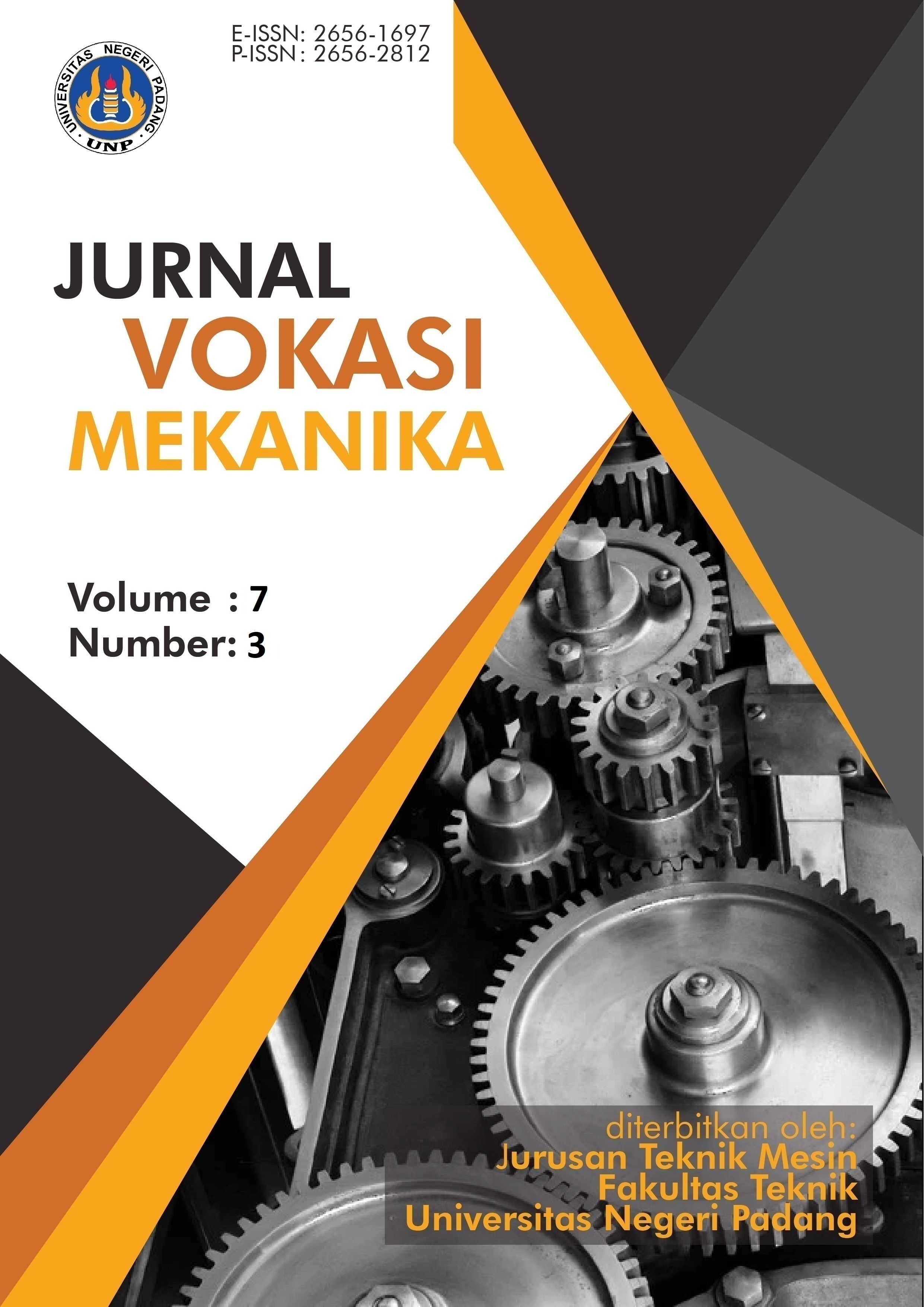
Effect of Problem Based Instruction (PBI) Model Assisted by Video on Learning Outcomes and Learning Motivation of Lathe Machining Engineering
DOI:
https://doi.org/10.24036/vomek.v7i3.892Keywords:
Effect of Problem Based Instruction (PBI) Model Assisted by Video on Learning Outcomes and Learning Motivation of Lathe Machining Engineering StudentsAbstract
This study analyzes the effect of a video-assisted Problem-Based Instruction (PBI) model on students’ cognitive learning outcomes, while controlling for learning motivation as a covariate. It was motivated by the low academic performance of Grade XI of lathe machining engineering. A quasi-experimental design with a post-test-only control-group format was employed. The sample comprised 62 students, divided into an experimental group (n = 32), which received the video-assisted PBI treatment, and a control group (n = 30), which was taught via conventional methods. Data were collected through an objective achievement test and a learning-motivation questionnaire, and were analyzed using Analysis of Covariance (ANCOVA). The results indicated a significant difference in mean post-test scores between the two groups, with the experimental group achieving a higher mean score (M = 85.2) than the control group (M = 74.4). ANCOVA confirmed that the video-assisted PBI model had a statistically significant effect on learning outcomes (F(1, 59) = 26.268, p < 0.001), with a large effect size (partial ?² = 0.308). Learning motivation also emerged as a significant covariate (F(1, 59) = 6.437, p = 0.014; partial ?² = 0.098), indicating a moderate influence. These findings suggest that the video-assisted PBI model is effective in enhancing cognitive achievement, and that students’ motivation plays an important supporting role.
Keywords: Problem Based Instruction; Video Learning; Learning Outcomes; Learning Motivation; Machining Engineering
Additional Files
Published
Issue
Section
License
Copyright (c) 2025 Jurnal Vokasi Mekanika (VoMek)

This work is licensed under a Creative Commons Attribution 4.0 International License.